

Short.io Review 2026
Complete analysis of features, pricing, and alternatives
Last updated April 2026
Short.io Overview
Short.io Screenshots
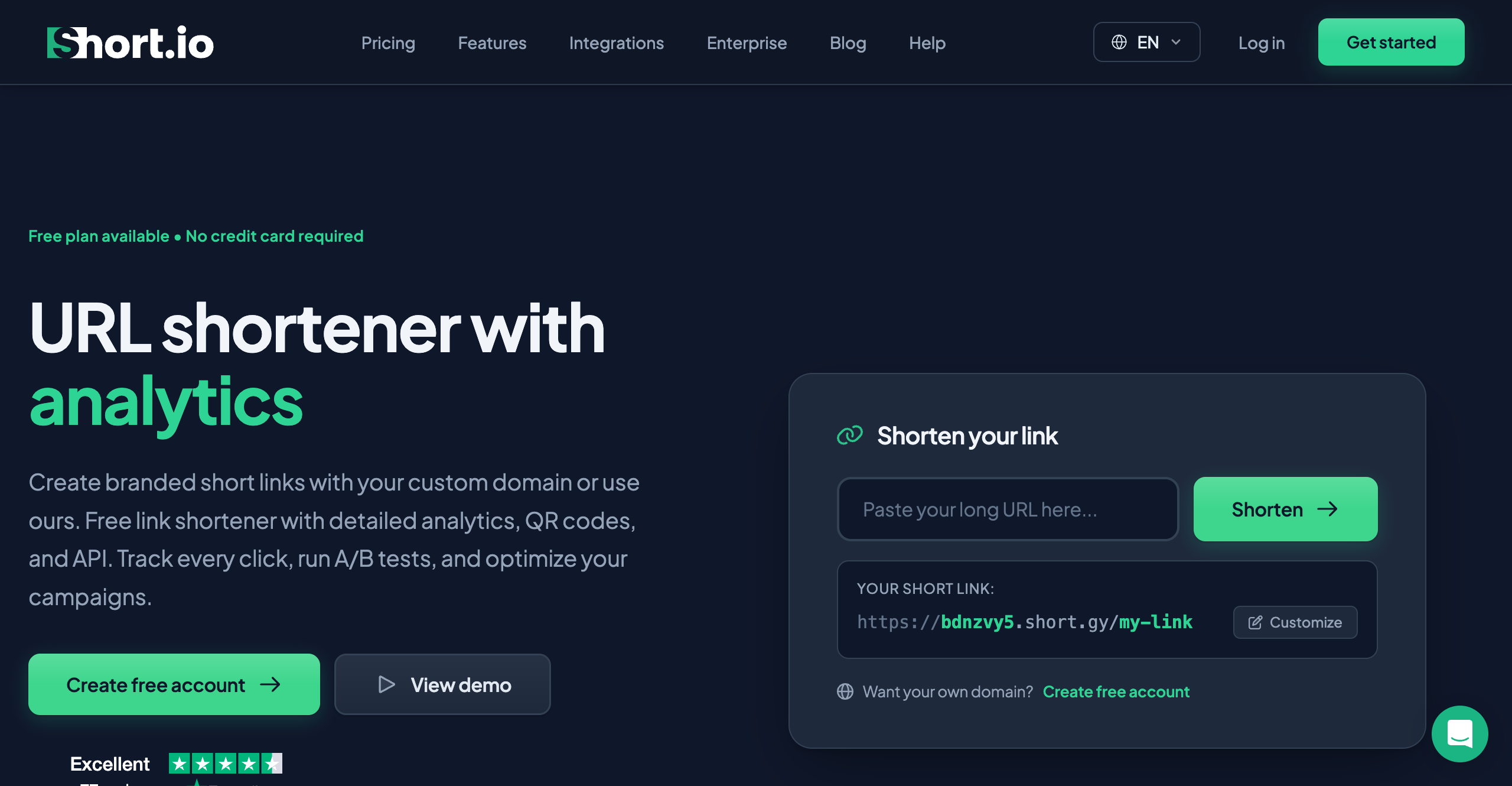
Homepage
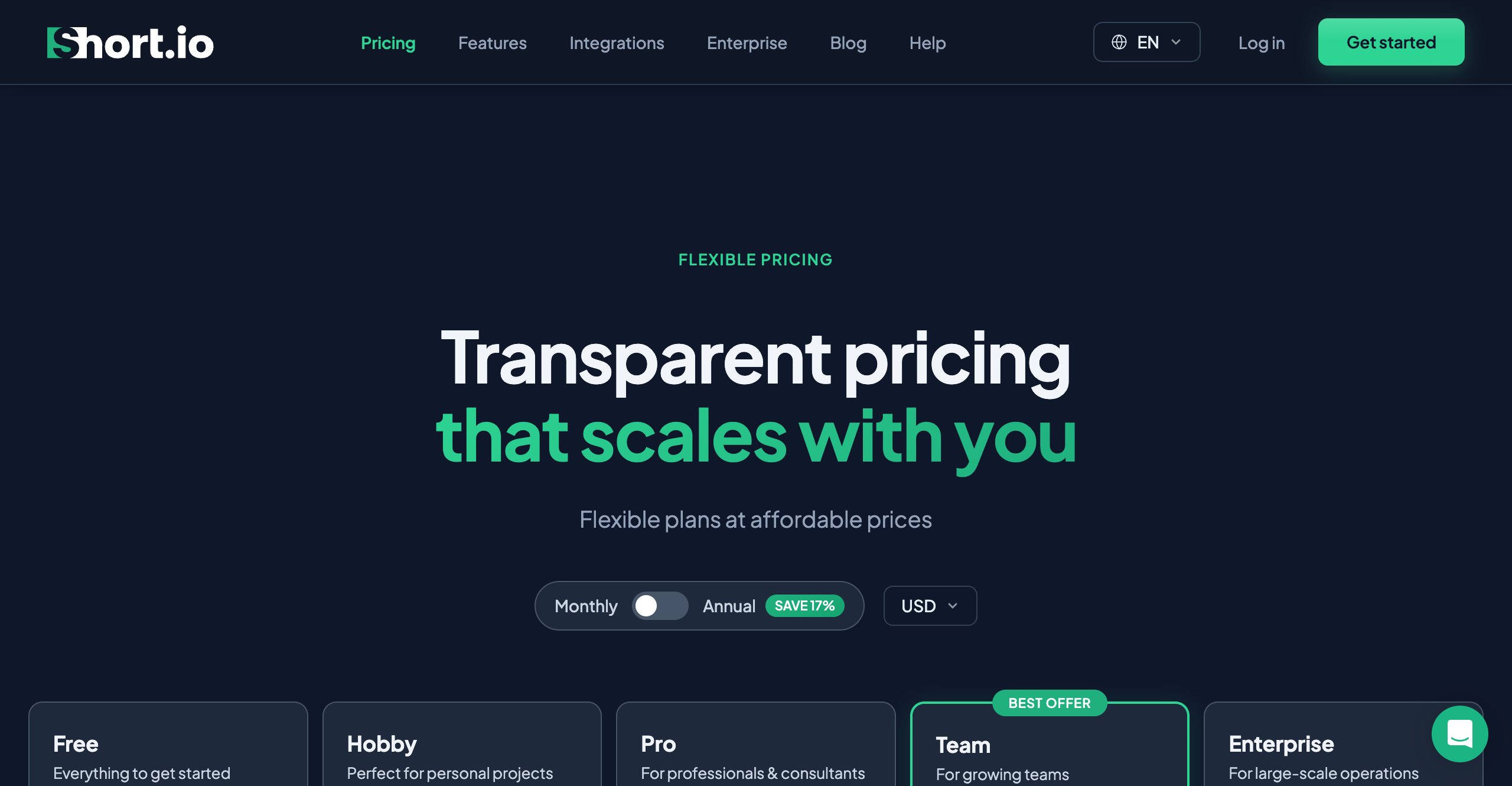
Pricing Page
Short.io Key Differentiator
Generous free tier; dev-friendly
Short.io Pricing
Short.io Features
- Branded domains
- Geo-targeting
- A/B testing
- Deep linking
- Bulk operations
- API
Short.io Target Users
- Marketers
- Businesses
- Developers
Short.io Integrations
- Zapier
- Google Analytics
- WordPress
- Slack
- Chrome extension
Short.io API
Short.io Compliance
Short.io Performance
Short.io is a URL shortener and link management platform founded in 2015 that has built a loyal following among developers and budget-conscious marketers. Based in Delaware with a distributed team, the platform handles over 100 million redirects daily and has earned a reputation for offering one of the most generous free tiers in the link shortening space. Where many competitors have steadily stripped features from their free plans, Short.io has gone in the opposite direction, offering 1,000 branded links and 50,000 tracked clicks per month at no cost. Combined with a developer-friendly API and affordable paid plans, Short.io has positioned itself as a practical alternative to pricier platforms like Bitly and Rebrandly. But every platform has trade-offs, and a closer look at Short.io's features, limitations, and pricing reveals where it shines and where it falls short.
Short.io Pricing
Short.io's pricing is refreshingly straightforward and meaningfully cheaper than most established competitors. The platform offers five tiers, each stepping up in link volume, click capacity, and domain allowances.
The Free plan is the standout. It includes 1,000 branded links, 50,000 tracked clicks per month, and 5 custom domains. This is not a token free tier designed to push you toward upgrading. For a small business, personal project, or developer experimenting with link management, 1,000 branded links is genuinely useful. Most competitors offer somewhere between 5 and 25 free links per month, making Short.io's free offering roughly 40 to 200 times more generous depending on who you compare it to.
The Hobby plan costs $5 per month and bumps the limits to 2,500 links, 100,000 tracked clicks, and 7 custom domains. At this price point, you're paying roughly the cost of a coffee for a meaningful upgrade in capacity. For freelancers, small agencies, or side projects that have outgrown the free tier, it's an easy decision.
The Pro plan at $18 per month is where Short.io becomes truly compelling. It includes unlimited links, unlimited tracked clicks, and 10 custom domains. For comparison, Bitly charges $35 per month for just 500 links with retention limits, and Rebrandly's comparable plan runs over $30 per month. Short.io's Pro tier delivers more for roughly half the price.
The Team plan at $48 per month adds unlimited team members, 50 custom domains, deep linking capabilities, and a 99.9% uptime SLA. This is positioned for growing teams that need collaboration features and reliability guarantees without enterprise pricing.
The Enterprise plan at $148 per month provides unlimited custom domains, SSO (single sign-on), and raw data export to S3. Even at the highest tier, Short.io is priced well below what competitors charge for enterprise features. Bitly's enterprise pricing requires a custom quote and typically runs into the thousands per month.
The overall picture is clear: Short.io is one of the most affordable link management platforms available, especially when you factor in the generous free tier and the unlimited links and clicks available from just $18 per month.
Short.io Features
Short.io covers the core feature set that most link management users need, with some pleasant surprises and a few notable gaps.
Branded domains are supported across every plan, including the free tier. You can connect your own custom domains and create short links that carry your brand rather than a generic shortener domain. Setting up custom domains is straightforward, and the fact that even free users get 5 domains is unusually generous.
Geo-targeting allows you to redirect users to different destinations based on their geographic location. This is useful for businesses operating in multiple markets where you need to send visitors to region-specific landing pages, localized content, or country-specific app store listings. Geo-targeting is typically a paid feature at other platforms, but Short.io includes it in its feature set.
A/B testing lets you split traffic between multiple destination URLs to test which landing page, offer, or creative performs better. You can set traffic distribution percentages and monitor performance to optimize your campaigns over time. Having A/B testing built into a URL shortener avoids the need for separate testing tools for simple link-level experiments.
Deep linking is available on the Team plan and above. This allows links to route mobile users directly into native app content rather than opening a web page. While Short.io's deep linking isn't as sophisticated as dedicated platforms like Branch.io, it covers the basics for teams that need simple app deep links without investing in a full mobile attribution stack.
Bulk operations support creating, editing, and managing large numbers of links at once. For teams managing hundreds or thousands of links across campaigns, this saves significant time compared to creating links one at a time.
The API is where Short.io's developer-friendly philosophy comes through most clearly. The platform offers a well-documented REST API along with an official Node.js SDK, making it easy to integrate link management into custom applications, internal tools, and automated workflows. Rate limits are generous relative to the plan tier, and the API covers link creation, analytics retrieval, domain management, and bulk operations.
On the integrations front, Short.io connects with Zapier for workflow automation, Google Analytics for combined tracking, WordPress for link management within your CMS, and Slack for notifications. A Chrome extension provides quick link creation from the browser toolbar. The integration list is functional but smaller than what you'll find with Bitly or Rebrandly, which offer more native connections to marketing platforms and enterprise tools.
Short.io is GDPR compliant and handles over 100 million redirects daily, so reliability at scale has been proven in production.
Short.io Pros and Cons
Pros:
- Best free tier in the market with 1,000 branded links and 50,000 clicks per month
- Highly affordable paid plans, with unlimited links and clicks starting at just $18 per month
- Developer-friendly with a clean REST API and official Node.js SDK
- A/B testing and geo-targeting included, features that competitors often gate behind expensive tiers
- Generous custom domain limits across all plans, including 5 on the free tier
- Simple, transparent pricing with no hidden fees or confusing credit systems
- Handles 100M+ redirects daily, demonstrating proven scale and reliability
Cons:
- No retargeting pixel support for platforms like Meta, Google Ads, or LinkedIn, a significant gap for paid media marketers
- Analytics are functional but less advanced than competitors, lacking the depth that data-driven marketing teams may need
- Smaller integration ecosystem compared to established players like Bitly
- No SOC2, HIPAA, or other enterprise security certifications, which may disqualify it for regulated industries
- Less established brand recognition, which can matter when presenting tools to clients or stakeholders
- Deep linking limited to Team plan and above, and less feature-rich than dedicated deep linking platforms
Short.io vs Linkly
Short.io and Linkly are both positioned as affordable, practical alternatives to Bitly, and both deliver strong value relative to their pricing. However, they prioritize different strengths, and the best choice depends on what matters most to your workflow.
Where Short.io wins is on raw link volume at the free tier. With 1,000 branded links and 50,000 clicks per month included at no cost, Short.io's free plan is hard to beat if your primary need is creating a large number of branded short links without paying anything. The paid plans are also exceptionally affordable, with unlimited links and clicks from $18 per month. For developers, Short.io's Node.js SDK and clean API make it a natural choice for building link management into custom applications.
Where Linkly wins is on marketing-specific functionality. Linkly includes retargeting pixel support for Meta, Google Ads, LinkedIn, TikTok, and other advertising platforms, allowing you to build retargeting audiences from anyone who clicks your links. This is a feature that Short.io simply does not offer, and for teams running paid media campaigns, it can be the deciding factor. Linkly also provides advanced routing rules that combine geographic and device-based targeting, Google Sheets live feeds that automatically push click data into spreadsheets for real-time reporting, and smart link rotation for traffic distribution.
You choose the plan that matches your click volume. Linkly offers a free plan with 500 tracked clicks per month, with paid plans starting at $39 per month for 25,000 tracked clicks.
Short.io's $18 per month Pro plan gives you unlimited links and clicks, which is excellent value for basic link management. But if you need retargeting pixels, advanced analytics, or marketing-specific features like Google Sheets integration, Linkly fills those gaps. The pricing models also differ fundamentally: Short.io prices by link count (unlimited on Pro), while Linkly prices by tracked click volume with no feature restrictions.
For developers who need to generate thousands of branded links programmatically, Short.io is a strong and cost-effective choice. For marketing teams and agencies who need their links to do more than redirect, Linkly's feature depth offers more return from every click.
The Bottom Line
Short.io is a solid, well-built URL shortener that delivers exceptional value for its price. The free tier is genuinely the best in the market for anyone who needs branded short links at volume without spending a dollar. The paid plans are among the most affordable available, and the developer experience, with a clean API and official Node SDK, makes it a practical choice for technical teams.
The trade-offs are real, though. The absence of retargeting pixel support means Short.io isn't the best fit for marketing teams whose campaigns depend on building remarketing audiences from link clicks. The analytics, while serviceable, don't offer the depth that data-driven marketers have come to expect. And the integration ecosystem, while growing, is still smaller than what more established platforms provide.
If your primary needs are branded link creation at scale, a developer-friendly API, and keeping costs low, Short.io is one of the best options available. If your workflow demands retargeting pixels, advanced routing rules, marketing analytics, and the ability to push data into tools like Google Sheets, a platform like Linkly will serve those needs better while still keeping pricing accessible. Both platforms prove that effective link management doesn't have to come with an enterprise price tag.
Looking for a Short.io Alternative?
Try Linkly - the powerful URL shortener with advanced analytics, custom domains, and reliable tracking.
Try Linkly Free