

Branch.io Review 2026
Complete analysis of features, pricing, and alternatives
Last updated April 2026
Branch.io Overview
Branch.io Screenshots
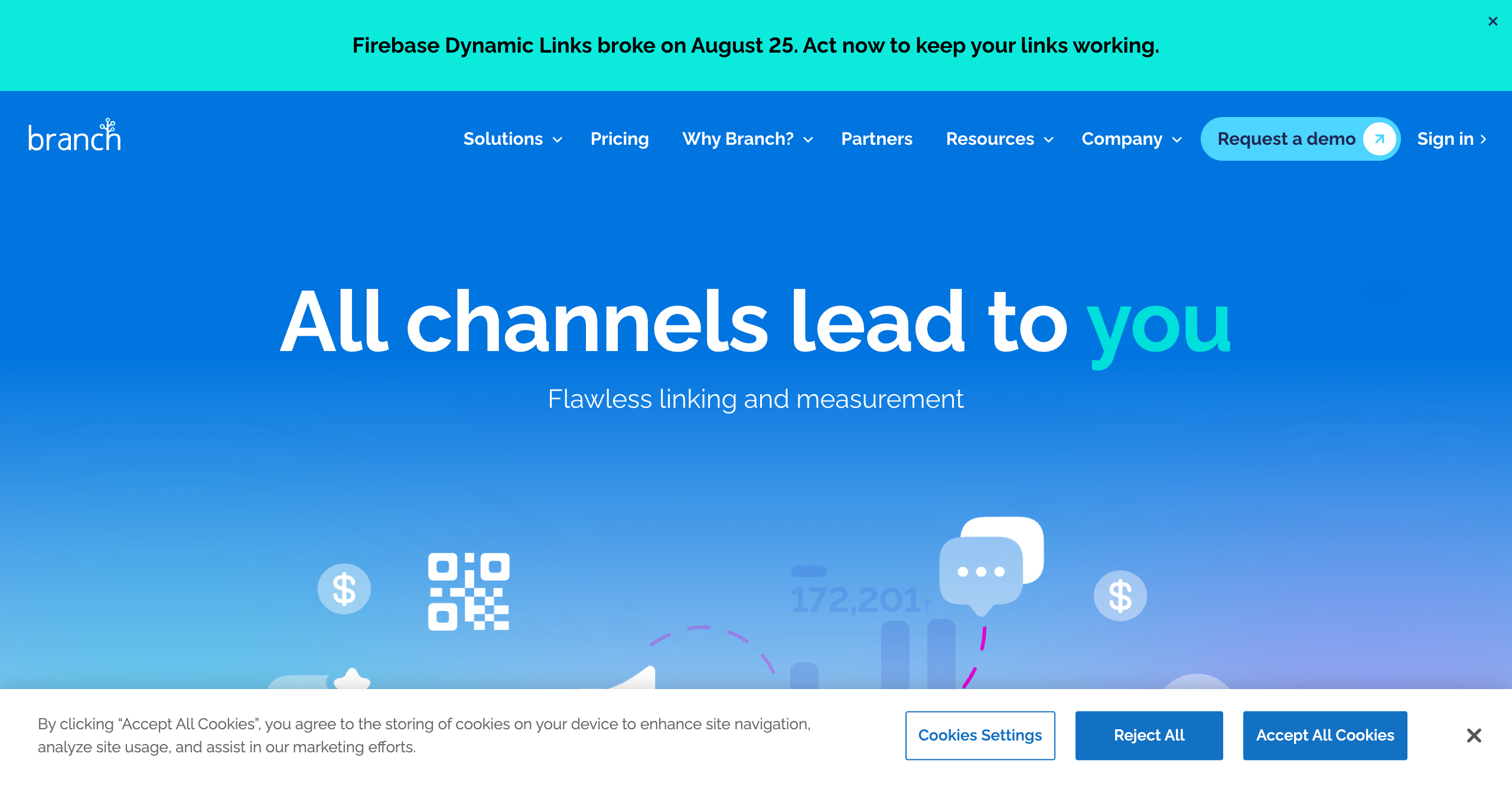
Homepage
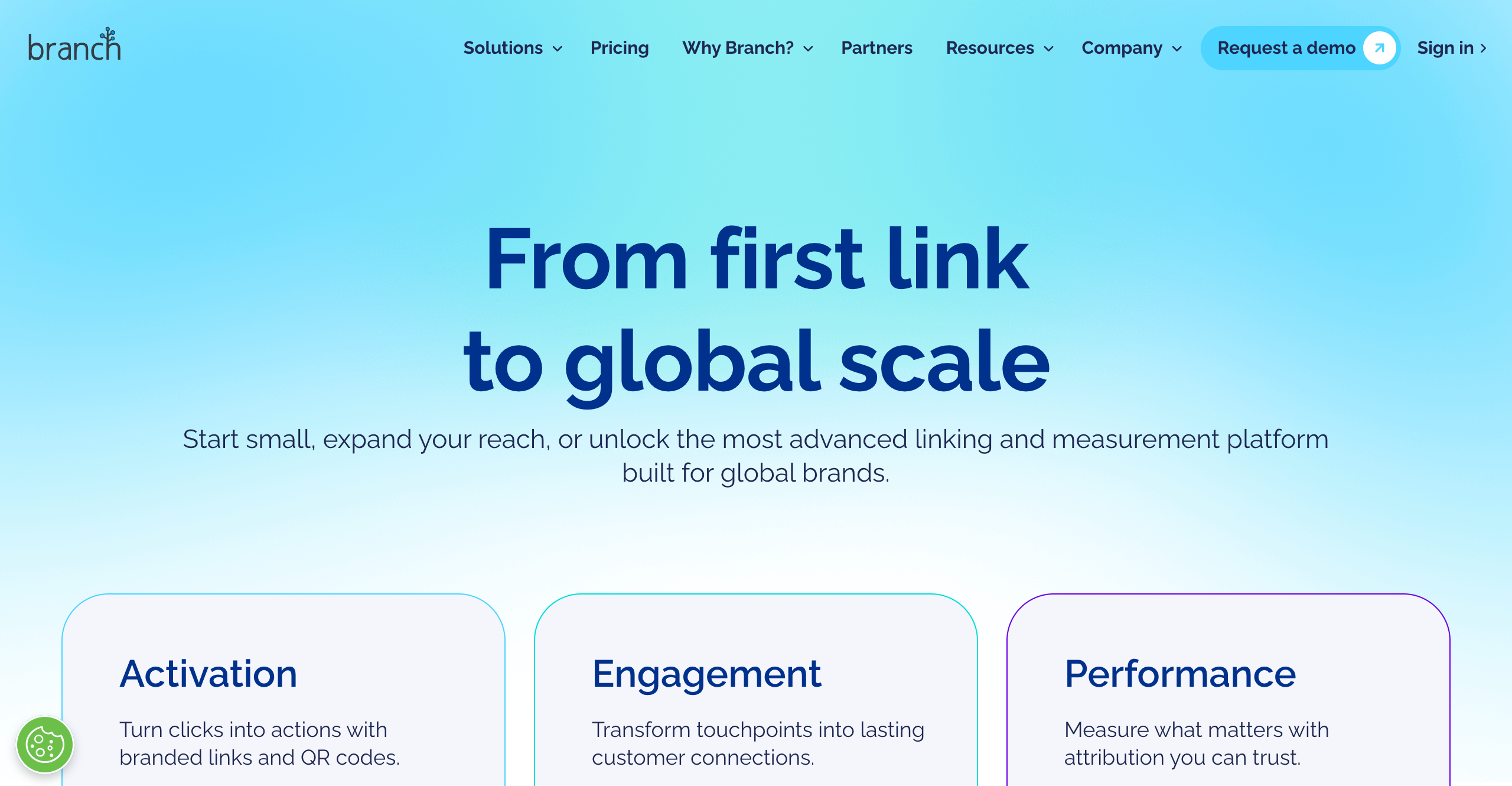
Pricing Page
Branch.io Key Differentiator
Mobile deep linking + enterprise attribution
Branch.io Pricing
Branch.io Features
- Universal Links
- App Links
- Deferred deep linking
- Attribution
- Data feeds
- SSO
Branch.io Target Users
- Enterprises
- Mobile-first companies
Branch.io Security
Branch.io Compliance
Branch.io is an enterprise-grade mobile deep linking and attribution platform founded in 2014 and headquartered in Palo Alto, California. The platform specializes in helping mobile-first companies create deep links that route users seamlessly into native app content, even through complex scenarios like deferred deep linking where the app isn't yet installed. Branch has carved out a strong position in the enterprise mobile space, counting major brands among its customers and earning an impressive roster of security certifications. But with pricing that starts at $199 per month and a volume credit system that can be difficult to forecast, it's worth asking whether Branch.io is the right fit for your needs or whether a more accessible alternative would serve you better.
Branch.io Pricing Breakdown
Branch.io structures its pricing across four tiers, each built around a system of "volume credits" that can make cost planning more complicated than it needs to be.
The Activation plan starts at $199 per month and includes 100,000 volume credits. This tier is positioned as the entry point and focuses on deep linking basics, helping companies drive users from web to app. At nearly $200 per month as the starting price, this is already well above what most link management platforms charge for full-featured plans.
The Engagement plan jumps to $499 per month, also with 100,000 volume credits. This tier adds tools for ongoing user engagement, including more sophisticated targeting and messaging capabilities. The fact that the volume credit allocation remains the same as the Activation tier while the price more than doubles suggests you're primarily paying for feature access rather than usage capacity.
The Performance plan is also priced at $499 per month with 100,000 volume credits, but focuses on attribution and analytics. This tier is designed for teams that need to understand which campaigns and channels are driving app installs and in-app activity. It's worth noting that splitting engagement and performance into separate plans at the same price point means companies that need both capabilities are looking at roughly $1,000 per month before they've exceeded any usage limits.
The Enterprise plan carries custom pricing and is designed for organizations with large-scale needs, dedicated support requirements, or specific compliance demands like FedRAMP authorization.
The "volume credits" system deserves particular scrutiny. Unlike straightforward pricing models where you pay per click, per link, or per user, volume credits are an abstraction layer that makes it harder to predict costs. Different actions consume different numbers of credits, and the relationship between credits and actual usage isn't always transparent. This opacity can lead to unexpected overages and makes it difficult to compare Branch.io's pricing directly against competitors who use more conventional billing models.
There is no free tier. Unlike many link management platforms that offer a generous free plan for small-scale users or evaluation purposes, Branch.io requires a financial commitment from day one.
What You Get With Branch.io
Branch.io's feature set is genuinely impressive if your primary need is mobile deep linking at enterprise scale.
Universal Links and App Links form the foundation of the platform. Branch handles the technical complexity of Apple's Universal Links and Android's App Links, ensuring that tapping a link on a mobile device opens the correct content inside a native app rather than falling back to a mobile web page. This is a genuinely difficult technical problem, and Branch handles it well.
Deferred deep linking is where Branch truly differentiates itself. When a user clicks a link but doesn't have the app installed, Branch can route them through the app store, wait for the install to complete, and then deep link them to the originally intended content on first launch. This creates a seamless user experience that's extremely difficult to build in-house.
Attribution and analytics provide insight into which marketing channels, campaigns, and touchpoints are driving app installs and downstream activity. For mobile-centric businesses spending significant amounts on user acquisition, this data can be valuable for optimizing marketing spend.
Data feeds allow you to export Branch's attribution and event data to your own data warehouse or analytics platform, which is important for enterprise teams that need to combine Branch data with other business intelligence.
SSO (Single Sign-On) support is included, which is a baseline expectation for enterprise software but worth noting for organizations with strict IT policies.
Where Branch.io stands apart from nearly every competitor is its security and compliance posture. The platform holds SOC2 Type 2, ISO 27001, HIPAA, and PCI certifications, and is FedRAMP authorized. This last certification is rare in the link management space and makes Branch essentially the only option for U.S. government agencies and contractors with strict compliance requirements. If your organization needs FedRAMP authorization from its link management vendor, the decision has effectively been made for you.
The weaknesses are equally clear. Branch.io is expensive relative to the broader link management market. It's complex to implement, typically requiring engineering resources to integrate the SDK, configure deep linking behavior, and maintain the integration over time. For teams that don't have dedicated mobile engineering resources, this complexity can be a significant barrier. The platform is also heavily focused on mobile, which means it's not the best choice for teams whose primary needs are web-based link management, marketing analytics, or general URL shortening.
Branch.io Pros and Cons
Pros:
- Industry-leading mobile deep linking technology, including deferred deep linking
- Comprehensive enterprise security certifications (SOC2 Type 2, ISO 27001, HIPAA, PCI)
- FedRAMP authorized, making it one of the only options for government and regulated industries
- Powerful mobile attribution and analytics for understanding user acquisition
- Robust data feeds for integrating with existing analytics infrastructure
- Proven at enterprise scale with major brand customers
Cons:
- Expensive, with pricing starting at $199 per month for the most basic tier
- Opaque pricing model based on volume credits rather than straightforward usage metrics
- Complex setup requiring engineering resources for SDK integration and configuration
- No free tier for evaluation or small-scale use
- Primarily mobile-focused, with limited value for web-based link management
- Engagement and Performance features split into separate plans at the same price, pushing combined costs toward $1,000 per month
- Overkill for teams that need simple link shortening, tracking, or marketing analytics
Who Should Use Branch.io?
Branch.io is purpose-built for a specific type of organization. If you fit the profile, it can be an excellent investment. If you don't, you'll likely be overpaying for capabilities you don't need.
Branch.io is a good fit for:
- Enterprise mobile-first companies that have native apps as their primary customer touchpoint and need sophisticated deep linking to drive users from web, email, ads, and social media into specific in-app content.
- App-heavy businesses running significant user acquisition campaigns where understanding attribution across channels is critical to optimizing marketing spend.
- Organizations with strict compliance requirements, particularly U.S. government agencies, defense contractors, healthcare companies, and financial institutions that need FedRAMP, HIPAA, or PCI compliance from their vendors.
- Companies with dedicated engineering teams that can handle SDK integration, ongoing maintenance, and the technical complexity that comes with Branch's platform.
Branch.io is probably not the right choice for:
- Small businesses that need basic link shortening and tracking without enterprise-level complexity or cost.
- Marketing teams looking for straightforward URL management, click analytics, A/B testing, and retargeting pixel support.
- Teams without dedicated mobile engineering resources, since Branch requires meaningful technical investment to implement and maintain.
- Organizations primarily working on the web rather than in native mobile apps.
- Budget-conscious teams that can't justify $199 per month as a starting point for link management.
Branch.io vs Linkly
Branch.io and Linkly serve fundamentally different segments of the link management market, and understanding where each excels helps clarify which is the right choice.
Branch.io is an enterprise mobile deep linking platform. Its core strength is routing users into native app content through Universal Links, App Links, and deferred deep linking. It includes powerful mobile attribution and carries security certifications that make it suitable for regulated industries. If your business revolves around a native mobile app and you need to optimize the web-to-app user journey at scale, Branch delivers capabilities that Linkly does not attempt to replicate.
Linkly is a marketing-focused link management platform. It's designed for teams that need to shorten URLs, track clicks, run A/B split tests, add retargeting pixels, create branded short domains, and understand how their links perform across campaigns and channels. Linkly focuses on making link management accessible and affordable without sacrificing functionality.
The pricing difference is stark. Branch.io starts at $199 per month with no free option. Linkly offers a free plan with 500 clicks per month, with paid plans starting at $39 per month for 25,000 tracked clicks. You simply pick the plan that matches your click volume.
For mobile app deep linking and enterprise attribution, Branch.io is the stronger platform. It was built specifically for this use case and has years of refinement behind it.
For general link management, marketing analytics, retargeting, A/B testing, and branded short links, Linkly provides a more complete and dramatically more affordable solution. Most marketing teams, agencies, and small-to-medium businesses will find that Linkly covers everything they need without the engineering overhead or enterprise price tag that Branch demands.
The Bottom Line
Branch.io is a serious platform built for a specific and demanding use case: enterprise mobile deep linking with best-in-class security compliance. If your organization operates primarily through native mobile apps, needs deferred deep linking, requires FedRAMP or HIPAA compliance from its vendors, and has the engineering resources to manage a complex integration, Branch.io is one of the best options available. The pricing, while high, may be justified by the value it delivers in that context.
For everyone else, Branch.io is likely more platform than you need and more cost than you should bear. If your goals center on link management, URL shortening, click tracking, marketing analytics, or retargeting, a platform like Linkly offers all of those capabilities starting from a free plan, with paid tiers that cost a fraction of Branch's entry price.
The right choice depends entirely on your use case. For enterprise mobile-first companies, Branch.io earns its price. For the broader world of link management and marketing, there are more accessible and affordable paths forward.
Looking for a Branch.io Alternative?
Try Linkly - the powerful URL shortener with advanced analytics, custom domains, and reliable tracking.
Try Linkly Free