

Hundreds of links. One domain. Real clicks, not noise.
A UK family events marketplace replaced fragile, hard-to-maintain affiliate and media partner links with branded Linkly links on its own domain — surviving platform switches in minutes instead of days, and finally getting an independent, trustworthy view of real click performance.
2–3 yrs
Using Linkly
customer since ~2023
100%
Links branded
on a custom domain
~100
Local businesses & partners
managed centrally
60,000+
Link interactions
over a 90-day period
Days → minutes
Platform switch
days of work saved
Summary
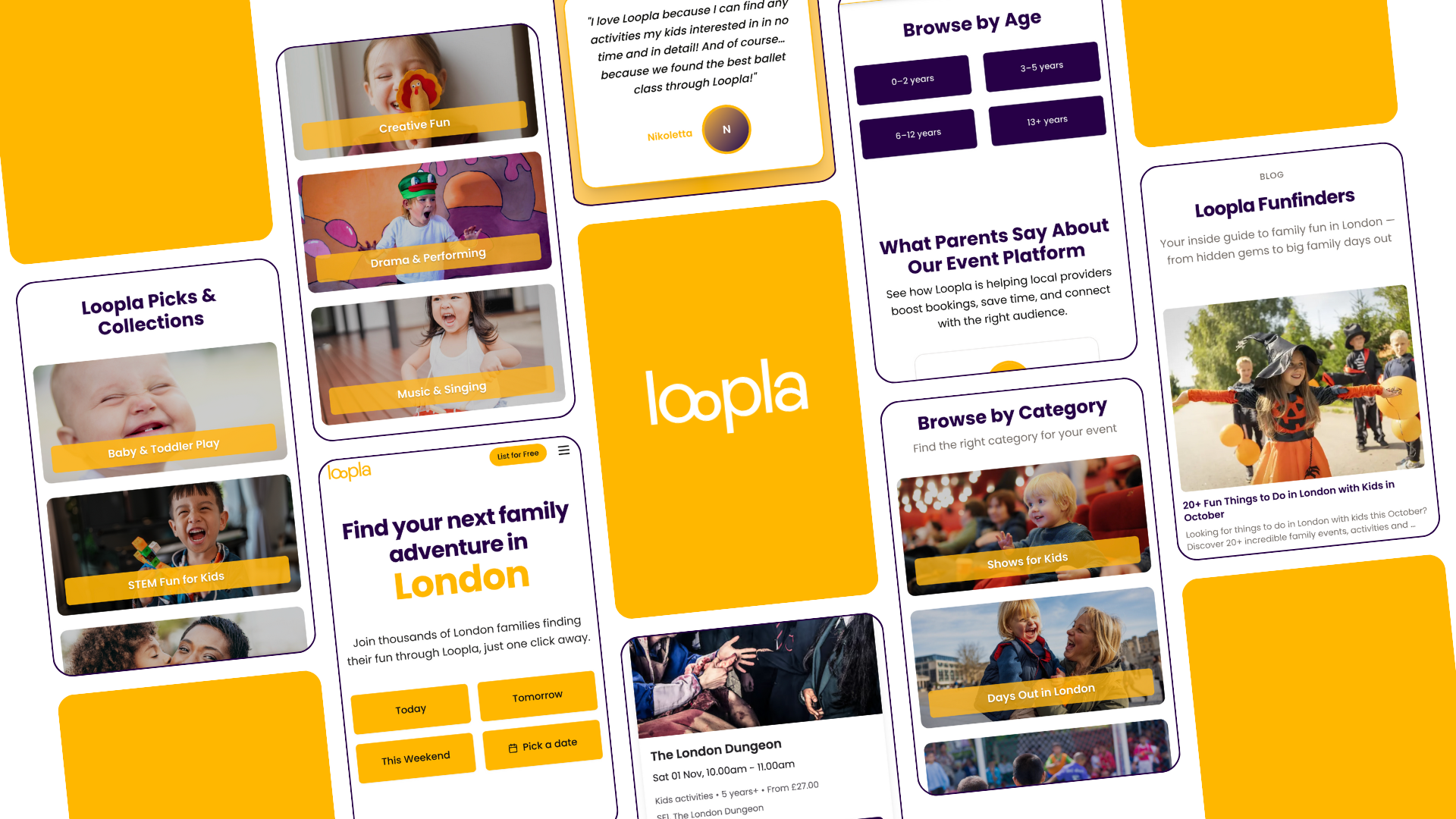
Loopla is a UK family events marketplace that helps parents find classes, clubs, camps, and days out for babies, toddlers, and children — and helps small local businesses reach families actively searching for what they offer. With a growing content library, a 30,000-subscriber newsletter, and affiliate links, media partner placements, and sponsored content across roughly 100 local businesses and media partners, Loopla needed a way to manage links centrally, brand them on its own domain, and verify performance independently.
Using Linkly, Loopla now runs 100% of its links on a branded custom domain, manages several hundred active links at any time, and tracks over 60,000 link interactions over a 90-day period, with the confidence that the numbers it reports to media partners and local businesses are real, not inflated by bot traffic.
Background: a single place for parents to find what's on
Loopla is a family events and activities marketplace. It helps parents find classes, clubs, and experiences for babies, toddlers, and children, and helps the local businesses who run them reach more families in their area. The idea grew out of founder Sophia Nomicos's own evenings spent searching online and comparing providers — she wanted one place where parents could search by location, age, day, time, and activity type and find what they need in seconds, not hours.
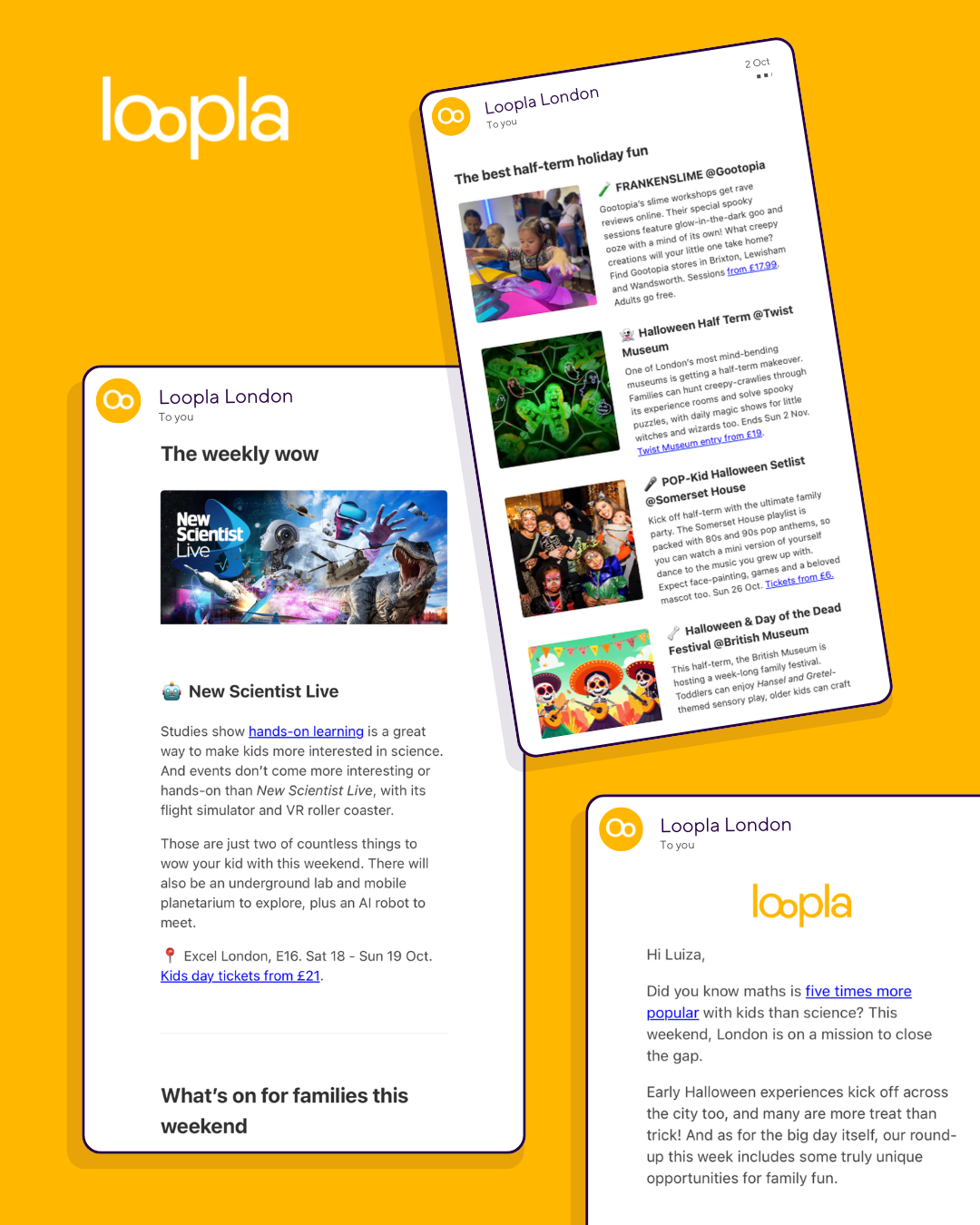
Alongside weekly classes and holiday camps, Loopla features family days out for weekends, and its what's-on newsletter for the city is a standout channel, with 30,000 parents subscribed.
The business side matters just as much. Most are small, local businesses without big marketing budgets. A free listing puts their classes in front of thousands of local parents who are already searching for exactly what they offer. Those who want more reach can pay for a premium layer: featured placement and promotion across Loopla's newsletter and channels that drives qualified local traffic to their own listings and sites. Because traffic and visibility are central to the premium offering, Loopla needs a reliable way to show businesses the value it delivers. Loopla also runs sponsored placements with media partners and uses affiliate links to booking platforms.
That mix of free listings, paid placements, media partnerships, and affiliate links is exactly what made centralized link management mission-critical.
The challenge: links that broke, multiplied, and couldn't be trusted
Before Linkly, Loopla inserted affiliate and media partner links directly into its content. The links were often long and unattractive, and while some platforms offered basic shorteners, the approach simply didn't scale as content and partnerships grew. Three problems compounded as the library expanded:
Link maintenance was a recurring time sink
Affiliate partners would occasionally switch networks, which instantly broke every link pointing to them. With around 100 links spread across articles, newsletters, and social content, each round of updates took hours of manual replacement.
Promotions left debris behind
When Loopla ran a temporary offer, there was no easy way to switch links back once it ended — leaving outdated or broken links live on the site.
The numbers couldn’t be verified
Loopla had no independent click analytics and relied entirely on the affiliate and partner platforms’ own reporting, making it impossible to confirm whether traffic and conversions were being attributed accurately.
“Affiliate partners would occasionally switch networks, which meant every link to them suddenly broke and needed replacing. At one point we had around 100 links spread across articles, newsletters and social content, with each round of updates taking hours to carry out.”
Sophia Nomicos
Founder, Loopla
That last point came to a head with a striking discrepancy. Loopla's newsletter software showed around 110 clicks on a particular link, while the affiliate platform reported roughly 30 across all campaigns. Which number was real?
The solution: branded links on Loopla's own domain, with an independent source of truth
Loopla had used another link management tool before, but its analytics fell short — particularly on traffic quality and click behavior. That visibility gap was a main reason Loopla switched to Linkly two to three years ago, drawn by the promise of more control, custom-domain branding, and the ability to change where a link points without editing it across dozens of articles and campaigns.
“We wanted more control over our links, better branding through custom domains, and the ability to change where a link points without editing it across dozens of articles and campaigns.”
Sophia Nomicos
Founder, Loopla
How Loopla uses Linkly today
Loopla's core workflow is simple and manual by design — and because every link is centrally managed, the destination can be updated in one place whenever it needs to change.
Take the destination URL
The team starts with a destination, an affiliate link or a media partner’s site, that they want to promote across their content and channels.
Generate a branded Loopla link
In moments, that destination becomes a branded link on Loopla’s own custom domain — recognizable, professional, and consistent wherever it’s shared.
Deploy everywhere, update in one place
The link goes out across articles, newsletters, social media, and partner campaigns. Because every link is centrally managed, the destination can be changed in one place whenever it needs to — no editing across dozens of placements.
Solving the discrepancy: seeing the real picture
When that 110-vs-30 click discrepancy surfaced, Linkly cleared it up quickly. A large share of the newsletter clicks turned out to be automated — the scanners and security bots that check links inside emails. It's a well-known characteristic of email click tracking rather than anything unusual to Loopla, and Linkly simply let the team see what was genuine without hours of back-and-forth with the affiliate platform.
Branding on 100% of links
Loopla now runs every link on its own branded domain. For a marketplace whose name needs to stay in front of parents wherever it shares, that consistency matters.
“A Loopla-branded link looks more professional and recognizable than a generic short link, and it keeps our brand in front of people wherever we share it.”
Sophia Nomicos
Founder, Loopla
The features that carry the day-to-day
Loopla's reliance is on a focused set of capabilities rather than the full feature surface:
- Custom domains — 100% of links branded as Loopla
- Fast link creation — generating branded links in moments
- Easy duplication — cloning existing links to save time
- Quick editing and updating — changing destinations centrally
- Reliable click tracking — an independent, trustworthy view of performance
The independence is the point. Because Linkly sits outside the affiliate and partner platforms, Loopla treats it as neutral data — a second set of numbers to check them against, especially where those platforms give limited visibility into geography, device, or traffic quality.
Trustworthy numbers: separating real clicks from internet noise
The bot-and-scanner visibility has become one of Loopla's most valued benefits — not for the technical detail, but for the confidence it gives.
“It's been valuable mainly because it lets me trust the numbers I report. Raw click counts can be inflated by automated scanners and security bots, which is normal across email and link tracking generally. … Seeing what's genuine keeps our reporting honest, both internally and with our media partners.”
Sophia Nomicos
Founder, Loopla
That confidence flows directly into how Loopla works with the businesses that pay for reach: when results are reported back to a media partner or local business, they're grounded in figures Loopla actually trusts.
Results
60,000+
Tracked link interactions over a 90-day period
A steady, directional view of engagement across paid, organic, and newsletter channels, measured independently of the affiliate and partner platforms.
Days → minutes
Platform switch handled
When an affiliate partner moved networks entirely, one destination change kept every existing link working.
Protected
Revenue & reputation
Independent tracking settles attribution questions quickly and prevents parents hitting broken links.
100%
Branded links
Every link reinforces the Loopla brand wherever it's shared.
The moment that crystallized the value was a partner switching platforms completely. Without Linkly, that meant updating links by hand across the entire content library. Instead, Loopla changed the destination once, in minutes, and every existing link kept working.
“One of our affiliate partners switched platforms completely. Without Linkly we'd have had to update links by hand across our whole content library. Instead we changed the destination in Linkly in minutes and every existing link kept working. So it clearly paid for itself.”
Sophia Nomicos
Founder, Loopla
And the time saved is matched by reputational protection — fewer chances for a parent to hit a broken or outdated link, which matters as much as the hours recovered.
Room to grow
Loopla's setup is intentionally focused, and it covers the essentials well. As the marketplace scales, the same Linkly foundation has room to do more:
- UTM parameters for channel comparison. Loopla uses UTMs only lightly today. Should it lean in, the goal would be comparing traffic quality by source — newsletter versus website versus paid campaigns — to direct effort and budget where it works best.
- Link tagging for organization. Loopla maintains a spreadsheet mapping events to partner brands, platforms, and URLs. Tagging links by platform or partner would make organizing and reporting easier; for now, naming conventions plus search handle it well.
These aren't fixes for problems Loopla has — they're headroom, room for the link infrastructure already in place to grow into a richer reporting and segmentation layer as the marketplace expands.
Frequently asked questions
What does Loopla use Linkly for?
Loopla, a UK family events marketplace, uses Linkly to brand, manage, and track its affiliate and media partner links centrally on its own custom domain — across articles, newsletters, social, and partner campaigns.
Why did Loopla switch to Linkly?
Loopla wanted more control over its links, custom-domain branding, the ability to change destinations without editing every placement, and — crucially — independent, detailed analytics on traffic quality that its previous tool didn’t provide.
How does Linkly help with attribution?
Because Linkly is independent of the affiliate and partner platforms, Loopla treats it as neutral data — a second source of numbers to verify their reporting and settle attribution questions quickly.
How much time has Linkly saved Loopla?
Days of work. When an affiliate partner switched platforms entirely, Loopla updated one destination in minutes instead of manually editing links across its whole content library.
“For our paid and media partner links, Linkly gives a clear view of what's driving clicks. Across a quarter that's well into the tens of thousands, being able to report that back to media partners with confidence is what matters most to me.” — Sophia Nomicos, Founder, Loopla
Take control of your links with Linkly
Join teams like Loopla who use Linkly to brand every link on their own domain — and trust the numbers they report.
Start for free